 angela
Choosing the right diesel industrial generator for a cannabis facility requires matching continuous power capacity to your cultivation or processing load, ensuring 24/7 reliability through proper sizing and redundancy, and meeting jurisdiction-specific emissions and noise regulations. Most commercial cannabis operations need between 100 kW and 500 kW of standby capacity, with larger multi-zone cultivation facilities pushing into the 750 kW to 1 MW range when supporting high-intensity lighting, HVAC systems, and processing equipment that cannot tolerate interruptions.
Cannabis production presents unique power demands. Grow rooms running on precise 12/12 light cycles cannot afford outages during critical flowering stages. Processing facilities handling live resin extraction or refrigerated storage face product loss measured in tens of thousands of dollars per hour of downtime. Dispensaries in regions with unstable grids need instant backup to preserve inventory climate control and maintain point-of-sale operations. Unlike general commercial applications, cannabis generators often function as extended-run prime power sources rather than true emergency standby units, particularly in rural cultivation sites where grid reliability remains poor or utility capacity insufficient for scale-up.
The decision extends beyond raw kilowatt output. You’ll need to evaluate fuel efficiency across multi-day runtime scenarios, acoustic enclosures that meet local sound ordinances without sacrificing cooling performance, and whether a single large unit or multiple smaller generators in parallel better suit your expansion timeline and redundancy strategy. Compliance adds another layer: California’s CARB Tier 4 emissions standards differ sharply from Colorado’s requirements, and many municipalities impose additional restrictions on stationary diesel equipment near residential zones.
This guide walks through the core selection factors, compares generator types by application fit, provides sizing recommendations across facility scales, and identifies the costliest mistakes operators make when specifying backup power for cannabis infrastructure.
Understanding Power Needs in Cannabis Cultivation Facilities
Cannabis cultivation facilities operate under power demands unlike almost any other commercial application. A single power interruption can destroy an entire crop, compromise product safety, and trigger regulatory violations that shut down operations. Understanding these specific electrical requirements is the foundation for selecting a generator that protects both your investment and compliance status.
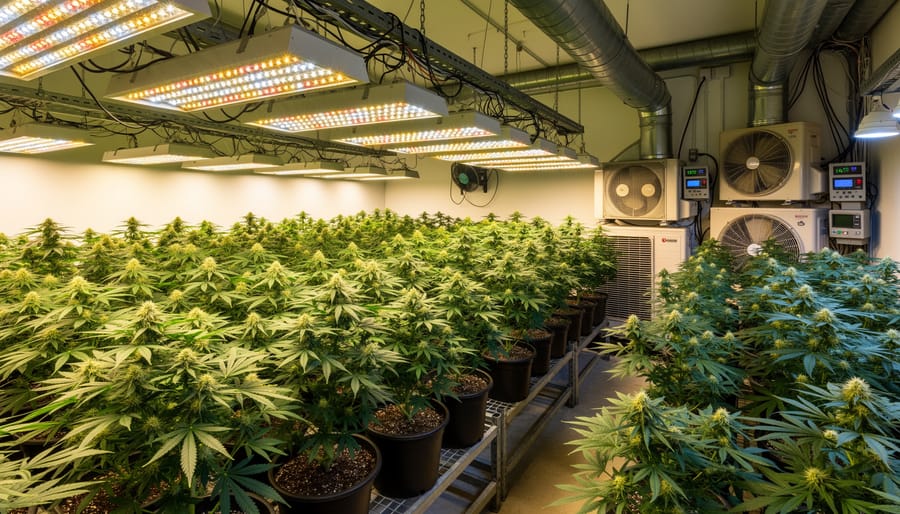
The largest power consumers in cannabis production are climate control and lighting systems. HVAC equipment runs continuously to maintain precise temperature and humidity ranges, typically consuming 40-60% of total facility load. High-intensity grow lights, whether HPS, LED, or hybrid arrays, add another 25-35% to the power bill while running on strict photoperiod schedules that can’t be interrupted without stressing plants. Dehumidification systems, essential for preventing mold in dense canopy environments, often draw 10-15% of capacity and must operate around the clock.
Beyond the major systems, cannabis facilities require reliable power for security cameras, access control, environmental monitoring sensors, and data logging equipment that regulatory agencies may review during inspections. Processing areas add extraction equipment, packaging lines, and refrigeration to the load calculation.
The distinction between critical and non-critical loads matters when designing backup power systems. Critical loads include anything affecting plant health, product safety, or regulatory compliance: grow room HVAC, lighting timers, security systems, and environmental controls. These systems require immediate transfer to generator power during an outage. Non-critical loads, office equipment, break rooms, administrative lighting, can be shed to reduce generator size requirements and fuel consumption.
In regulated cannabis markets, power reliability isn’t just about protecting revenue. State regulators often require facilities to maintain specific environmental conditions and complete documentation. A multi-hour outage that raises grow room temperatures above permitted ranges or interrupts security monitoring can result in product quarantine, failed inspections, or license suspension. This regulatory reality makes generator backup systems a compliance requirement rather than an optional investment for most commercial operations.
Key Buying Factors for Diesel Industrial Generators
Power Rating and Load Requirements
Start by auditing every piece of equipment in your facility. List lighting systems with their actual wattage (not equivalent ratings), HVAC units, dehumidifiers, fans, pumps, security systems, and any processing equipment. For each item, record the nameplate rating in kilowatts. Cannabis cultivation facilities typically run 300-800 watts per square foot of grow space when accounting for HID or LED lighting plus climate control, significantly higher than most commercial buildings.
Understanding kVA versus kW ratings prevents costly sizing errors. Generators are rated in kilovolt-amperes (kVA), which represents apparent power, while your equipment consumes real power measured in kilowatts (kW). The relationship between them depends on power factor, typically 0.8 in cannabis facilities due to motor-driven HVAC equipment. To convert your kW total to required kVA capacity, divide by 0.8. For example, 160 kW of equipment demands a minimum 200 kVA generator (160 ÷ 0.8 = 200).
Motor startup surge creates temporary power demands far exceeding steady-state operation. Dehumidifiers, chillers, and ventilation fans can draw three to six times their running current when starting. Calculate your largest motor’s starting requirement, add it to the running load of all other equipment, and size your generator to handle this peak. A 10-ton chiller might run at 12 kW but require 40 kW during startup.
Plan for 20-30% expansion capacity when selecting your generator. Cannabis operations frequently add grow rooms, upgrade to higher-output lighting, or install additional processing equipment. Oversizing slightly costs less now than replacing an inadequate unit within two years.
Fuel Efficiency and Operating Costs
Fuel consumption is often the largest operational expense for diesel generators, making efficiency analysis essential for cannabis producers. At 100% load, industrial diesel generators typically consume 0.27 to 0.32 gallons per kW hour, but efficiency deteriorates sharply below 50% load, a critical consideration since cannabis facilities rarely run generators at full capacity during grid outages.
Prime power applications demand more rigorous efficiency scrutiny than standby units. A 500 kW generator running continuously at 75% load consumes approximately 90-110 gallons daily, translating to substantial fuel costs over thousands of operating hours annually. Standby generators, exercised weekly for 30 minutes and deployed only during outages, consume far less fuel despite potentially lower efficiency ratings per hour.
Total cost of ownership extends beyond fuel. Budget for oil changes every 250-500 hours, filter replacements, coolant service, and periodic major overhauls at 10,000-15,000 hours. Prime power units require more frequent maintenance intervals, adding $0.015-0.025 per kWh to operating costs compared to $0.005-0.010 for standby models that run infrequently.
Calculate your break-even point between diesel pricing and grid electricity. Cannabis facilities in regions with $0.20+ per kWh utility rates may justify prime power operation, while those paying $0.10-0.12 typically use generators only for backup. Factor in demand charge reductions for peak shaving applications, which can offset fuel costs when strategically deployed during high-rate periods. Request manufacturers’ specific fuel curves showing consumption at 25%, 50%, 75%, and 100% load for accurate financial modeling.
Emissions and Environmental Compliance
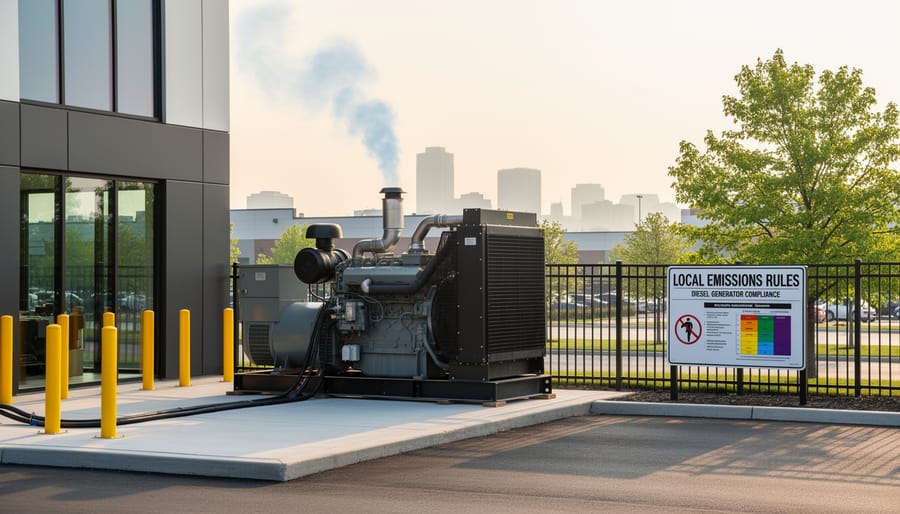
Diesel generators produce nitrogen oxides, particulate matter, and other emissions that fall under strict air quality regulations. Most jurisdictions require air permit requirements for stationary diesel units above certain power thresholds, with specific limits on operating hours and emissions rates. Cannabis facilities must navigate these rules carefully, as operating in heavily regulated industries already puts operations under close scrutiny.
Tier 4 Final emission standards represent the current benchmark for new diesel engines, delivering dramatically lower particulate matter and NOx output than older units. When evaluating generators, compare certification levels and understand what maintenance practices keep engines within compliance. Some models include diesel particulate filters or selective catalytic reduction systems that reduce emissions but add maintenance requirements.
For cannabis brands emphasizing sustainability, the emissions profile creates tension. While diesel generators provide unmatched reliability, they don’t align with environmental messaging unless paired with strategies like biodiesel fuel use, limited runtime through careful load management, or integration with renewable energy systems. Review local air quality regulations early in planning, as permit denials or restrictions can derail entire projects. Some municipalities impose stricter standards in cannabis zoning areas or limit backup generator testing schedules, directly affecting your ability to verify system readiness.
Durability and Maintenance Requirements
Cannabis cultivation operates on tight margins where a single power interruption can destroy an entire crop cycle worth hundreds of thousands of dollars. This reality makes generator durability and maintenance accessibility paramount, not optional considerations.
When evaluating build quality, examine the engine block construction, cast iron blocks withstand thermal cycling and vibration better than aluminum in continuous-use scenarios. Check the alternator’s insulation class rating (Class H withstands higher temperatures) and whether cooling systems use radiator or heat exchanger designs, as the latter handles enclosed installation environments better. Generator enclosures should offer weather protection rated to IP54 or higher, with corrosion-resistant materials essential in humid grow environments.
Service intervals vary dramatically by application type. Standby generators typically require oil changes every 200-500 hours of operation or annually, whichever comes first. Prime power units running continuously need maintenance every 250-500 hours, potentially monthly for 24/7 operations. Factor these intervals into your operational budget, as a 500 kW unit may consume 15-20 quarts of oil per change at $8-12 per quart for synthetic diesel oil.
Parts availability determines whether a failure means hours of downtime or weeks. Choose manufacturers with established distributor networks and avoid models approaching end-of-life production, as parts sourcing becomes progressively difficult. Confirm local availability of filters, belts, and common wear components before purchase. Request mean time between failure (MTBF) data for critical components, reputable manufacturers provide this for industrial applications.
Annual maintenance contracts typically cost 2-4% of the generator’s purchase price but guarantee priority service and prevent the false economy of deferred maintenance leading to catastrophic failure during an actual power emergency.
Installation and Infrastructure Needs
Generator placement demands careful planning in cannabis facilities where regulatory compliance intersects with operational efficiency. Position the unit to meet local setback requirements, typically 10 to 50 feet from property lines and building openings, while ensuring service access for maintenance crews and fuel delivery trucks.
Fuel storage presents critical compliance challenges. Above-ground tanks require secondary containment and fire suppression systems, while underground installations need leak detection. Cannabis facilities must navigate both standard petroleum storage regulations and cannabis-specific facility codes. Plan for adequate capacity based on expected runtime: a 150 kW generator running at 75% load consumes roughly 10 gallons per hour, necessitating 500-gallon minimum storage for extended outage protection.
Transfer switch placement should minimize voltage drop from the generator to critical panels. Automatic transfer switches typically require 18 to 36 inches of clearance and coordination with existing electrical infrastructure. Position them near main distribution panels to reduce conductor runs.
Noise mitigation matters in mixed-use areas or where cultivation neighbors residential zones. Weatherproof enclosures reduce sound by 15 to 25 decibels but require adequate ventilation clearances. Some jurisdictions limit generator operation to specific decibel levels at property lines, often 60 to 70 dB during daytime hours.
Types of Diesel Industrial Generators Compared
Stationary vs Portable Diesel Generators
Cannabis producers face a fundamental choice between stationary and portable diesel generators, each designed for distinct operational scenarios. Understanding these differences prevents costly mismatches between equipment and facility needs.
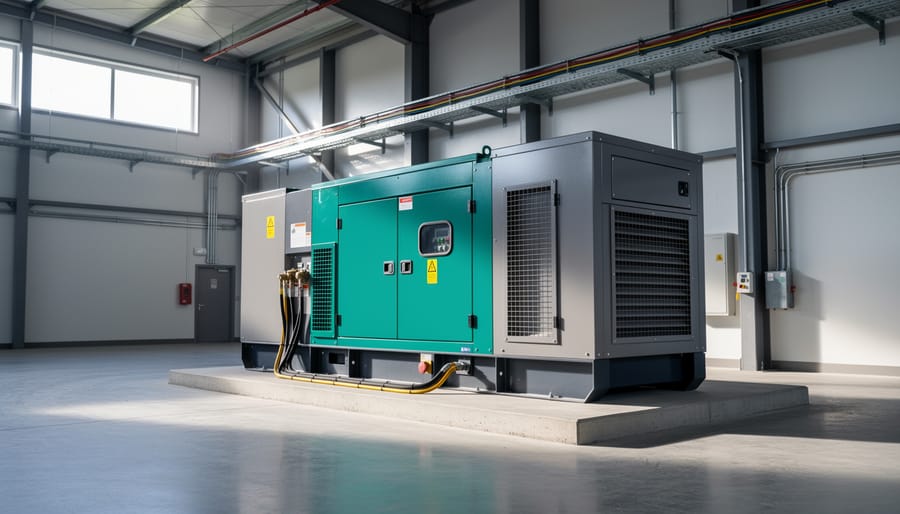
Stationary generators are permanently installed units mounted on concrete pads with dedicated fuel systems and hardwired electrical connections. These range from 20 kW to several megawatts, though cannabis facilities most commonly deploy units between 100-750 kW. Installation requires professional electrical work, concrete foundation preparation, fuel tank placement, and transfer switch integration. The upfront investment is substantial, expect $15,000-$50,000 for a complete 150 kW system including installation, but these units deliver automatic startup during outages and seamless integration with facility power systems. They’re built for extended runtime with robust cooling systems and weather-resistant enclosures.
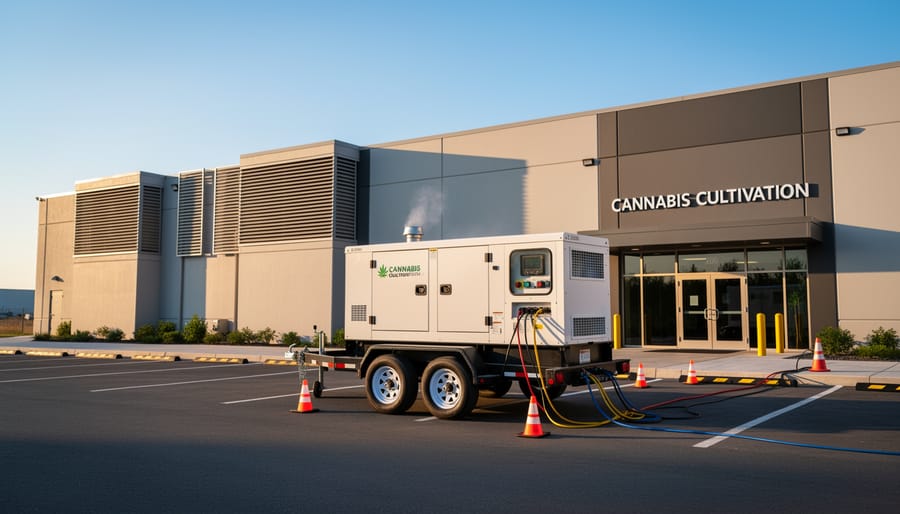
Portable generators mount on trailers or skid frames for relocation. Power output typically caps at 500 kW, with most models in the 10-150 kW range. These units cost less initially, a quality 100 kW portable runs $8,000-$20,000 without installation, and offer flexibility to move between locations or redeploy as operations expand. However, they require manual setup, external fuel connections, and temporary power cables that pose safety considerations in production environments.
Small craft operations under 5,000 square feet sometimes benefit from portable generators as cost-effective backup, particularly if they’re leasing space or planning facility changes. The mobility also allows sharing one unit across multiple small sites.
Mid-size and large commercial cannabis facilities almost universally choose stationary installations. The automatic transfer capability is critical when every hour of climate control downtime risks thousands in crop loss. Permanent generators integrate cleanly with security systems and maintain the professional infrastructure expected in regulated production environments. The higher initial cost becomes irrelevant compared to the reliability requirements of 24/7 cannabis operations where power interruption directly threatens product quality and regulatory compliance.
Standby Power Generators
Standby diesel generators serve as automatic backup systems that activate within seconds when grid power fails, a critical safeguard for cannabis facilities where even brief outages can compromise climate control, disrupt light cycles, or shut down security systems. These units monitor incoming utility power continuously and detect voltage drops or complete failures, triggering an automatic transfer switch that seamlessly shifts the facility load to generator power without human intervention.
Most standby generators for cannabis applications deliver 30-500 kW capacity, sized to handle essential loads rather than the facility’s full power demand. This targeted approach reduces capital costs while protecting temperature-sensitive grow rooms, maintaining ventilation systems that prevent mold growth, and keeping extraction equipment operational during processing runs. The automatic transfer typically completes in 10-30 seconds depending on the system configuration, fast enough to prevent crop damage in most scenarios, though particularly sensitive operations may require uninterruptible power supplies to bridge the brief transition.
Runtime limitations distinguish standby generators from continuous-duty units. These systems are built for intermittent operation during outages, not sustained use as primary power sources. Manufacturers typically rate standby generators for 200-500 hours of annual operation, with individual run cycles limited to 24-48 hours before requiring cooldown and maintenance. For cannabis facilities in areas with reliable grid power but occasional weather-related outages, this duty cycle provides adequate protection. However, locations experiencing frequent or prolonged blackouts should evaluate prime power generators instead, as exceeding standby duty ratings accelerates wear and voids warranties.
Prime and Continuous Power Generators
Prime and continuous power generators represent the most robust tier of diesel generation equipment, engineered for extended runtime and serving as the primary electricity source rather than emergency backup. Unlike standby units designed for occasional outages, these generators feature heavy-duty engine blocks, reinforced cooling systems, and components rated for thousands of operating hours between service intervals.
Cannabis producers deploy prime power generators in two distinct scenarios. Remote cultivation sites without reliable grid access depend on these units as their main power source, running continuously to support 24/7 environmental controls and lighting cycles. The enhanced durability justifies the higher upfront cost when grid connection proves prohibitively expensive or unavailable in rural agricultural zones.
The second application involves strategic energy cost management at grid-connected facilities. Large-scale operations in markets with high demand charges or time-of-use electricity pricing use prime power generators to reduce their utility bills. By running generators during peak rate periods while drawing grid power during off-peak hours, facilities can achieve substantial savings despite diesel fuel costs. This approach works particularly well where natural gas isn’t available for combined heat and power systems.
Continuous power generators include additional specifications beyond prime units, designed for non-stop operation year-round with only scheduled maintenance shutdowns. Cannabis processors in jurisdictions with exceptionally high industrial electricity rates sometimes find continuous diesel generation economically viable, though this represents a minority use case given fuel expenses and emissions considerations that conflict with sustainability positioning many cannabis brands pursue.
Peak Shaving Applications
Peak shaving uses diesel generators to strategically reduce electricity costs during periods of maximum grid consumption. Large cannabis cultivation facilities often face substantial demand charges, fees based on their highest instantaneous power draw during a billing period, not total energy used. A single spike in consumption can set the demand charge rate for an entire month, making these fees a significant operational expense for facilities running energy-intensive grow lights and HVAC systems around the clock.
By running diesel generators during predictable peak demand windows, operators can cap their grid power draw below the threshold that triggers higher demand charges. The generator supplies the portion of load that would otherwise push consumption into premium pricing territory. This approach differs from backup power: the generator runs on a planned schedule, typically a few hours daily during utility peak periods, rather than waiting for grid failures.
The economics work best for facilities with consistent, high baseline loads and steep demand charge structures in their utility rate schedule. Cannabis operations with 500 kW or higher continuous consumption often see meaningful returns, as avoiding just a few dollars per kW in monthly demand charges can offset diesel fuel costs and generator amortization. However, operators must factor in maintenance cycles, fuel storage logistics, and local air quality regulations that may limit permitted runtime hours for non-emergency operation.
Generator Recommendations by Facility Size and Application
Small-Scale Craft Cannabis Operations (Under 5,000 sq ft)
Small-scale craft cannabis operations under 5,000 square feet typically need standby generators in the 50-150 kW range to protect essential loads during grid outages. A 75-100 kW unit handles most boutique facilities, providing sufficient capacity for climate control systems, primary lighting circuits, dehumidification equipment, and security systems while remaining cost-effective.
For craft growers, stationary standby generators offer the best value proposition. These units automatically activate during power failures and provide several hours of runtime, enough to ride out typical outages or implement controlled shutdowns of sensitive crops. Expect investment ranges from $15,000 to $45,000 installed, depending on capacity and site preparation requirements.
Portable generators appeal to budget-conscious startups or those testing facility concepts before committing to permanent infrastructure. A quality 80 kW portable diesel unit costs $8,000-$18,000 but requires manual starting and lacks automatic transfer capabilities. You’ll sacrifice convenience and response time, which matters when minutes count for temperature-sensitive plants.
The critical consideration isn’t just matching peak load, it’s identifying which circuits absolutely cannot lose power. Many craft operations successfully operate on 60-75 kW backup by shedding non-essential loads during outages rather than oversizing to cover everything simultaneously. Work with an electrician familiar with cannabis facilities to map your true critical load before selecting capacity, as undersizing wastes money while oversizing creates unnecessary upfront costs.
Mid-Size Commercial Facilities (5,000-20,000 sq ft)
Mid-size commercial cannabis facilities sit in a challenging position: large enough to require substantial power infrastructure, yet needing to control capital expenditures during expansion. For operations between 5,000 and 20,000 square feet, you’re typically looking at generator capacity in the 150-500 kW range, depending on your cultivation density and climate control approach.
Most facilities in this category benefit from a stationary standby generator in the 200-300 kW range. This handles essential loads including HVAC, dehumidification, and a significant portion of your lighting array. A Tier 3-certified diesel unit at this capacity runs roughly $40,000-$75,000 installed, excluding fuel storage and transfer switch integration. If you’re running dual flower rooms on staggered schedules, calculate your peak simultaneous load rather than total connected load.
Prime power becomes economically viable for some mid-size operations, particularly in regions with expensive utility rates or unreliable grid service. A 350 kW prime-rated unit costs more upfront but can reduce demand charges substantially if you operate it strategically during peak rate periods. Run the numbers: if your facility pulls 250 kW average with $15/kW demand charges, offsetting even 40% of peak demand saves $18,000 annually.
Consider future expansion when sizing. Installing a 400 kW unit now costs less than replacing a 200 kW generator in three years when you add processing space. Leave capacity headroom or plan your electrical infrastructure for parallel units.
Large-Scale Industrial Cannabis Production (20,000+ sq ft)
Large-scale industrial cannabis production demands sophisticated power strategies that go beyond simple backup. Facilities exceeding 20,000 square feet typically require 500 kW to multiple megawatts of generating capacity, often deployed in multi-unit configurations rather than single massive generators. This approach provides critical redundancy: if one 750 kW unit fails, two others can maintain essential operations while repairs proceed.
For these operations, prime power diesel generators become economically viable when electricity rates exceed $0.12-0.15 per kWh or where demand charges significantly impact monthly utility bills. Running generators during peak pricing periods while drawing grid power during off-peak hours can reduce annual energy costs by 30-40% in facilities with consistent baseloads above 500 kW. The fuel cost savings offset generator capital investment within 3-5 years in many commercial cannabis markets.
Redundancy planning requires N+1 configuration at minimum, total capacity exceeds maximum load by at least one generator unit. Sophisticated facilities implement N+2 for mission-critical operations where product loss from power failure could exceed $100,000 per hour. Each generator should handle 60-70% of peak load when operating together, allowing continued operation if one unit drops offline during simultaneous equipment startup.
These installations demand parallel switchgear, automatic load sharing controls, and sophisticated fuel management systems. Bulk fuel storage typically ranges from 2,000 to 10,000 gallons, sized for 48-72 hours of prime power operation without refueling. Working with experienced integrators who understand both generator paralleling and cannabis facility requirements is essential for these complex deployments.
Processing and Extraction Facilities
Processing facilities demand precise power quality for temperature-sensitive extraction equipment and safety systems. Unlike cultivation’s HVAC-heavy load profile, processing operations run sophisticated hydrocarbon extraction systems, vacuum ovens, and refrigeration units that cannot tolerate voltage fluctuations or sudden shutdowns.
Generator selection starts with understanding extraction method requirements. Closed-loop hydrocarbon systems need clean, stable power for control panels and safety monitors, voltage spikes risk equipment damage and safety incidents. Ethanol extraction facilities require reliable power for chillers and rotary evaporators, while distillation operations depend on consistent heat control. Calculate both continuous loads and transient surges from refrigeration compressor startups.
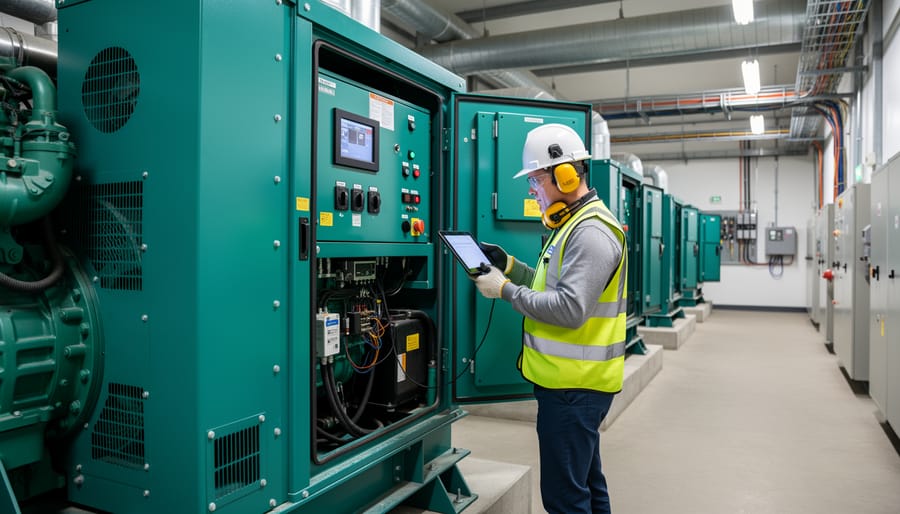
Most processing facilities operate well with 75-250 kW standby generators, smaller than cultivation facilities of similar square footage. Focus on power quality features: low total harmonic distortion (under 5%), tight voltage regulation (±2%), and fast transfer switching to protect sensitive electronics. Models with digital voltage regulators deliver the clean sine wave these operations demand.
Processing environments prioritize safety redundancy over raw capacity. Install automatic transfer switches with millisecond-level response times to maintain uninterrupted power to ventilation systems during extraction runs, fresh air exchange prevents dangerous vapor accumulation. Consider dual smaller units over one large generator to provide backup redundancy for critical safety systems, ensuring ventilation and monitoring equipment never go offline even during generator maintenance.
Common Mistakes to Avoid When Purchasing
Undersizing for Startup Surge Requirements
One of the costliest errors cannabis facility operators make is sizing generators based solely on steady-state running loads without factoring in startup surge demands. When motors in HVAC systems, dehumidifiers, and lighting ballasts start simultaneously, common during power restoration, they draw three to seven times their normal operating current for several seconds. A 20kW HVAC compressor might pull 100kW or more during startup, and if three major systems attempt to start at once, the surge can exceed your generator’s capacity even when the calculated running load looks adequate.
Cannabis facilities face particular risk because climate control failures mean product loss within hours. You can’t stagger equipment restarts the way an office building might. Your environmental controls, dehumidification, and lighting must resume operation immediately to protect crops worth thousands per square foot. Add security systems and processing equipment to the equation, and undersized generators trip offline precisely when you need them most.
Proper sizing requires listing every motor’s locked rotor amperage, not just its nameplate rating, then calculating worst-case simultaneous starts. Work with electrical engineers who understand diversity factors for cannabis operations. Plan for at least 25% capacity beyond your calculated peak surge requirement. This buffer accounts for future expansion and ensures reliable starts even in cold weather when diesel engines and electrical loads both demand more power.
Ignoring Local Regulations and Permitting
Many cannabis facility operators underestimate the regulatory complexity surrounding diesel generator installations, discovering permitting obstacles only after purchasing equipment. Noise ordinances often restrict operating hours or require sound-attenuation enclosures that add substantial costs, urban cannabis facilities face particularly strict limits, sometimes capping generator noise at 55 decibels at property lines. Emissions requirements vary dramatically by jurisdiction, with California’s stringent CARB Tier standards requiring specific engine certifications that not all industrial generators meet.
Fuel storage regulations present another frequent stumbling block. Storing the diesel quantities needed for extended runtime triggers environmental permits, secondary containment requirements, and minimum setback distances from property boundaries. These rules multiply when combined with cannabis-specific facility codes governing flammable material storage near cultivation or processing areas.
The permitting timeline itself catches operators off guard. What seems like a straightforward equipment purchase becomes a six-month approval process involving air quality boards, fire marshals, building departments, and cannabis regulators. Start the permitting process before generator purchase, consult with local inspectors early, and build regulatory compliance costs into your total budget, they often equal 15-25% of the generator investment.
Neglecting Maintenance and Service Access
Many cannabis operators focus exclusively on upfront generator costs, overlooking the reality that maintenance expenses often exceed the initial purchase price over a ten-year lifespan. A 200 kW diesel generator might cost $40,000, but routine servicing, oil changes every 200-500 hours, filter replacements, and eventual component overhauls can add $50,000 or more across its operational life.
The mistake compounds when facilities choose generators based on price without verifying local technician availability. Cannabis operations can’t afford three-day waits for a qualified diesel mechanic during a generator failure. Before purchasing, confirm that authorized service providers operate within your region and stock parts for your specific model.
Physical access matters too. Installing a generator in a tight corner surrounded by grow equipment makes routine maintenance difficult and emergency repairs nearly impossible. Plan for clearance around all service panels, oil drain points, and filter locations. Your maintenance team needs space to maneuver tools and replacement components, not contortionist skills.
Calculate true ownership costs including scheduled services, emergency repair budgets, and the value of downtime in your facility before selecting a model.
Failing to Test and Exercise Generators Regularly
A generator that sits idle for months will likely fail when you need it most. Cannabis facilities that skip regular testing discover this during power outages, often losing entire crops worth tens of thousands of dollars because backup systems haven’t been properly exercised.
Run your diesel generator under load at least monthly for 30 minutes minimum. This prevents fuel degradation, keeps engine seals lubricated, charges the battery system, and reveals developing problems before they become critical failures. Cannabis operations should increase testing frequency to weekly during peak growing seasons when crop value is highest.
Your testing protocol must include load bank testing quarterly, not just no-load operation. Running generators without proper load causes wet stacking, unburned fuel accumulates in the exhaust system, degrading performance and potentially causing complete engine failure. Load banks simulate real power demands your cultivation equipment creates.
Document every test with logs recording runtime, oil pressure, coolant temperature, voltage output, and any abnormal sounds or vibrations. These records help technicians spot trends indicating needed repairs and prove regulatory compliance during facility inspections. Assign specific staff responsibility for testing rather than assuming someone will handle it, accountability ensures the protocol actually happens.
Consider automated monitoring systems that track generator health parameters and alert management to failures, especially valuable for multi-facility cannabis operations where generators may be distributed across different locations.
Market Context and Investment Considerations
The diesel generator market is currently in a strong expansion phase, with cannabis producers entering a mature and competitive industrial landscape. The global market was valued at USD 19.26 billion in 2026 and is projected to reach USD 25.61 billion by 2031, reflecting steady demand across industrial sectors. This market size and CAGR of 5.9% indicates reliable manufacturer commitment and service network stability that cannabis facility operators can count on for long-term support.
For cannabis producers, this market health translates to several practical advantages. Equipment availability across power ratings remains robust, with manufacturers offering models from compact 50 kW units suitable for craft operations to multi-megawatt systems for industrial-scale facilities. The diversity of applications covered, including standby, prime power, and peak shaving configurations, means cannabis producers can find purpose-built solutions rather than compromising with equipment designed for different use cases.
Pricing in 2026 reflects this competitive landscape. Expect to invest approximately $300 to $500 per kW for quality industrial standby generators in the 100-500 kW range, with larger prime power units commanding $400 to $700 per kW due to enhanced durability specifications. Installation typically adds 15 to 30 percent to equipment costs depending on facility complexity and transfer switch requirements. Cannabis facilities should budget accordingly, recognizing that total project costs for a properly sized backup power system often reach $100,000 to $500,000 for mid-size commercial operations.
Supply chain considerations have stabilized compared to earlier years, though lead times for custom configurations or specialized models still run eight to sixteen weeks. Cannabis producers planning new facilities or expansions should integrate generator procurement into early construction timelines rather than treating it as a late-stage addition. Working with established distributors who stock common sizes can reduce wait times for standard applications, while custom solutions require advance planning to avoid delaying facility commissioning dates.
Working with Installers and Service Providers
Finding the right installation partner for your diesel generator system is as critical as selecting the equipment itself. Cannabis facility operators should prioritize contractors who hold experience with both industrial generator installations and regulated cannabis environments, as these professionals understand the intersection of power reliability requirements and compliance obligations unique to this industry.
Start by verifying that potential installers carry appropriate licensing for electrical work, mechanical systems, and fuel storage installation in your jurisdiction. Request references specifically from other cannabis production facilities or similarly regulated operations where downtime carries significant financial consequences. A qualified contractor should be able to walk you through their approach to load calculations, transfer switch integration, and how they’ll coordinate with your local utility and building officials throughout the permitting process.
When evaluating installation proposals, ask these essential questions before committing:
- What specific experience do you have with generator installations in cannabis facilities or other 24/7 operations?
- How will you handle permitting, inspections, and coordination with local authorities?
- What is your timeline from contract signing to final commissioning and testing?
- Do you provide load bank testing as part of the installation process?
- What warranty do you offer on installation workmanship separate from equipment warranties?
- Can you provide emergency service or have partnerships with service providers in our area?
Service agreements deserve equal scrutiny. Look for contracts that specify preventive maintenance schedules aligned with manufacturer requirements, typically quarterly inspections for standby units and more frequent service for prime power applications. The agreement should clearly outline response times for emergency calls, parts sourcing procedures, and whether the provider stocks common components for your generator model locally.
Build relationships with diesel mechanics who understand generator control systems, not just general engine repair. Ask about their training certifications from major manufacturers and whether they maintain diagnostic equipment specific to the generator brands you’re considering. Emergency service availability matters enormously in cannabis operations where extended outages risk entire harvests, so confirm that your service provider offers 24/7 response and maintains adequate staffing to reach your facility within a reasonable timeframe during critical failures.
Frequently Asked Questions
How long can a diesel generator run continuously?
Standby generators are typically rated for 200-500 hours of continuous operation per year with cooling periods between extended runs, while prime power generators designed for continuous use can operate 24/7 with regular maintenance intervals every 250-500 hours depending on the manufacturer. Cannabis facilities using generators as primary power should select units specifically rated for continuous duty to avoid premature wear.
What fuel storage capacity do I need for my cannabis facility?
Calculate fuel needs based on your generator’s consumption rate at expected load levels and desired runtime between refills. A 250 kW generator running at 75% load typically consumes 15-18 gallons per hour, so a 500-gallon storage tank provides roughly 24-30 hours of runtime. Most cannabis operations install 500-1,000 gallon tanks for multi-day outage protection, though local regulations may limit on-site fuel storage requiring permits for tanks exceeding specific capacities.
Can diesel generators integrate with solar power systems?
Yes, diesel generators can work alongside solar installations in hybrid configurations where solar provides primary daytime power, batteries store excess energy, and the diesel generator serves as backup or handles peak demand periods. This approach reduces fuel consumption and operating costs while maintaining the reliability cannabis operations require, though it demands sophisticated control systems to manage the transition between power sources.
What noise levels should I expect from industrial diesel generators?
Standard industrial diesel generators produce 65-75 dB at 23 feet (7 meters) during operation, roughly equivalent to heavy traffic or a vacuum cleaner. Sound-attenuated enclosures can reduce noise to 55-65 dB, making them suitable for locations with noise restrictions or proximity to residential areas. Cannabis facilities in urban settings or shared industrial parks typically require enclosed models to meet local noise ordinances, which can add 20-40% to equipment costs.
Do I need special permits to install a diesel generator at my cannabis facility?
Most jurisdictions require building permits, electrical permits for transfer switch installation, and environmental permits addressing air quality and fuel storage. Cannabis facilities face additional scrutiny during permitting due to industry-specific regulations, so plan for 6-12 weeks lead time and engage contractors familiar with both generator installation and cannabis facility requirements to navigate the approval process.
How often does a diesel generator need maintenance?
Preventive maintenance intervals depend on usage, but standby generators typically require service every 6-12 months or after 100-200 hours of operation, whichever comes first. Prime power generators running continuously need more frequent attention with oil changes every 250-500 hours and comprehensive inspections every 1,000-2,000 hours. Budget 2-4% of the generator’s purchase price annually for routine maintenance and repairs.
What happens if my generator fails during a power outage?
Generator failure during an outage can result in catastrophic crop loss, spoiled product, and regulatory violations if environmental controls fail in licensed cannabis facilities. This risk makes redundancy planning critical for commercial operations, either through dual generator configurations with automatic failover or maintaining service contracts guaranteeing rapid emergency response. Weekly exercise testing identifies potential issues before they cause failures during actual emergencies.
Beyond these common questions, cannabis facility operators should consult with both generator specialists and cannabis industry consultants when planning power infrastructure. The intersection of heavy electrical loads, strict regulatory compliance, and product value at stake makes generator selection more complex than standard industrial applications. Working with professionals who understand both the technical requirements and cannabis-specific operational constraints helps avoid costly mistakes and ensures your backup power system performs when needed most.
Selecting the right diesel industrial generator represents one of the most consequential infrastructure decisions for cannabis producers. Get it wrong, and you’re looking at crop losses from power failures, regulatory violations, or budget-draining operating costs that erode profitability. Get it right, and you’ve built a foundation for reliable operation that protects your investment while meeting both production demands and environmental commitments.
The market offers abundant options, with industrial diesel generators forming part of a sector worth USD 19.26 billion in 2026 and growing at 5.9% annually. But availability doesn’t simplify your decision. The choice requires balancing competing priorities: the non-negotiable reliability that cannabis production demands against environmental responsibility that increasingly defines the industry, all while maintaining economic viability in a competitive market.
There’s no universal formula. A craft cultivator operating 3,000 square feet faces entirely different considerations than a facility manager overseeing 50,000 square feet of canopy. What works for standby backup in grid-connected facilities won’t serve remote operations running on prime power. Your specific power profile, local regulations, budget constraints, and growth trajectory all shape the optimal solution.
That’s precisely why thorough needs assessment matters. Calculate your actual loads including surge requirements, understand your local regulatory landscape, evaluate total ownership costs beyond the purchase price, and consult with specialists who’ve worked in cannabis production environments. This infrastructure investment determines whether your facility operates reliably or faces costly disruptions, making expert guidance worth every dollar.