 angela
The best portable power station for most Canadians is one built on LiFePO4 chemistry with true 120V pure sine wave output, because that combination handles winter outages, cold garages and sensitive electronics better than anything else we tested. Of our six picks, the EcoFlow Delta Pro leads for whole-home backup and high output, while the Anker SOLIX S2000 earns its place for anyone who wants LiFePO4 longevity at home.
In the interest of transparency, we earn a commission on some purchases made through links on this site. As an Amazon Associate I earn from qualifying purchases.
Canadian buyers face a different set of problems than the spec sheets suggest. Sub-zero temperatures change how lithium batteries charge. Winter daylight is short, which limits solar recharging. Your fridge, furnace blower and sump pump all run on 120V, so output wattage and surge handling matter as much as raw capacity.
Our shortlist spans the full range. At the compact end, the BLUETTI Elite 30 Mini (288Wh, 300W) suits light loads like phones, laptops and a router. At the other, the Jackery 2000 v2 and the Anker SOLIX S2000 (2,010Wh, 1,500W) cover extended camping and serious home backup. The ALLPOWERS R2500 V2 and Anker C1000 Gen 2 sit between them, balancing power, portability and value.
Below, we explain how we evaluated each unit, what to check before buying a portable power station in Canada, and where each model fits.
Our Top Picks at a Glance
Not every household needs the same unit, so here is the shortlist in the order we’d point most readers toward it. Each pick maps to a different situation, from whole-outage backup to a phone-and-router carry-along.
- EcoFlow Delta Pro: Best overall for whole-home backup and the heaviest loads, thanks to its high output.
- ALLPOWERS R2500 V2: Best for mid-size backup, pairing strong output with enough capacity for essential winter outage appliances.
- Anker SOLIX S2000: Best for LiFePO4 longevity at home, with a 2,010Wh battery and 1,500W output.
- Jackery 2000 v2: Best for extended off-grid camping and cabin trips.
- Anker C1000 Gen 2: Best value in practice, balancing power, portability and cost for short outages and road trips.
- BLUETTI Elite 30 Mini: Best compact option for light loads, with 288Wh capacity and 300W output.
If you want a single recommendation from this portable power station Canada shortlist, the EcoFlow Delta Pro covers the widest range of backup needs. For tighter budgets, the Anker C1000 Gen 2 is the most sensible mid-range middle ground, while the BLUETTI Elite 30 Mini sits at the budget end for people who only need to keep small electronics running. Anyone searching for the best portable battery Canada has to offer should start by deciding which of these jobs they actually need done, then jump to the matching pick below. Availability shifts often, so confirm that a given power station Canada listing is current before you commit.

How We Evaluated These Portable Power Stations
Why You Can Trust This Roundup
We’re a nonprofit, and that shapes how this roundup gets built. Our editorial work is kept strictly separate from any business function, so no brand can pay for a place on the list or nudge a ranking. That editorial independence is the point of the exercise: if a unit earns a spot, it’s because of how it performs against the criteria we set out above.
To keep our judgment grounded, we lean on research communities and consumer buyer groups, not on manufacturer talking points. Their experience with cold-weather charging, real appliance loads and Canadian warranty coverage tells us more than a spec sheet alone. Where something can’t be verified, we say so instead of guessing, and we’d rather you confirm a detail with the maker than trust a claim we can’t back up.
What Canadian Buyers Need to Know Before Choosing a Power Station
LiFePO4 in the Cold: Charge Cut-Offs and Winter Behaviour
LiFePO4 stands for lithium iron phosphate, a battery chemistry prized for long life and thermal stability. It has one cold-weather quirk that matters in Canada: most units restrict or block charging when the cells drop below freezing. The reason is cell protection. Pushing current into a frozen lithium cell can cause lithium metal to plate onto the anode (the negative electrode), which permanently reduces capacity and can create safety risks. To prevent that, the battery management system (BMS), the unit’s built-in electronic safeguard, simply refuses to accept a charge until the cells warm up.
Discharging is more forgiving. Many units will keep powering your router, lights or a CPAP in sub-zero air, although available capacity and output can dip as the cold slows the chemistry. So a unit can run a load in a cold garage yet refuse to recharge from a wall outlet or solar panel there.
A few habits help, whether you choose a large unit like the Anker SOLIX S2000 or a compact one like the BLUETTI Elite 30 Mini:
– Store the power station indoors or in a heated space, not in an unheated shed or vehicle.
– Bring a cold unit inside to warm up before plugging it in to recharge.
– Look for the operating range and the separate charging range in the spec sheet, since the two are often different.
Treat those published temperature ranges as a key buying criterion for any portable power station in Canada, because they decide whether your backup battery can refill during a January outage.
120V Pure Sine Wave Output and What It Means for Your Appliances
Canada’s household standard is 120V AC at 60Hz, and the AC outlets on a portable power station are built to match it. Your lamp, laptop charger or router plugs straight in, just as it would at home. What matters more is the shape of the electricity coming out, and that’s where the inverter comes in.
An inverter converts the battery’s direct current into household alternating current. A pure sine wave inverter produces a smooth, clean waveform like the grid does, which is what CPAP machines, laptops, audio gear and anything with a motor or compressor expects. Cheaper modified sine wave designs can make motors run hot and noisy, and some sensitive electronics simply refuse to work on them. If you want a primer on how these inverters work, our guide to generator inverter basics covers the fundamentals.
Here are the terms you’ll see on every spec sheet:
- Continuous output
- The wattage a unit can supply steadily without shutting down, such as 1,500W for the Anker SOLIX S2000 or 300W for the BLUETTI Elite 30 Mini.
- Surge output
- A brief, higher burst of power the inverter can deliver to start motors and compressors, usually lasting only a moment.
- Pure sine wave
- A smooth AC waveform that matches grid power and suits sensitive electronics and motor loads.
- Watt-hours (Wh)
- The amount of energy the battery holds, which sets how long a load can run, such as the 2,010Wh in the Anker SOLIX S2000.
In practice, continuous rating decides what you can run, and surge rating decides whether it starts. A fridge may draw modest power while running but demand a much larger jolt at startup, so check both numbers against your appliance’s label before buying.
What Each Capacity Class Can Run During a Winter Outage
Runtime comes down to simple arithmetic. Take the battery’s watt-hours, multiply by roughly 0.85 to account for inverter losses, then divide by the watts your load actually draws. A 1,000Wh unit running a 100W load gives about 8.5 hours, not 10.
Cycling loads like a fridge need a different lens. The compressor only runs part of the time, so average draw is well below the label rating, which stretches runtime. Furnace blowers and CPAP machines vary by model, so check the wattage on the appliance itself and use that figure in the formula.
| Capacity class | Realistic outage loads | Not realistic |
|---|---|---|
| Compact (the BLUETTI Elite 30 Mini, at 288Wh and 300W, is the example here) | Router, phone and laptop charging, LED lights | Fridge, furnace blower, heaters |
| Mid-size (around 1,000Wh, such as the Anker C1000 Gen 2) | Router, lights, CPAP overnight, short fridge support | Anything heating-related, multiple big loads at once |
| Large (around 2,000Wh and up, such as the Anker SOLIX S2000 at 2,010Wh and 1,500W) | Fridge plus furnace blower plus lights and charging, for part of an outage | Electric heat or a full-house load |
In practice, the compact class suits staying connected, the mid-size class covers essentials for a short outage, and the large class can carry a fridge and furnace blower together for a while. Whatever the class, the continuous watt rating caps what you can run at once, and the watt-hours decide how long it lasts. Add up your must-run loads before comparing any portable power station in Canada, because a long winter outage punishes a unit that was sized by guesswork.
Duty, Shipping and Buying a Portable Battery in Canada
Where you buy matters as much as what you buy. A Canadian storefront usually quotes a landed total, with duties and taxes already handled. A US storefront can look simpler, but the order may pick up duty, brokerage or handling fees at the border, and those arrive after checkout. Ask the seller who is responsible for them before you pay.
Warranty is the next thing to check. Some manufacturers honour coverage only for purchases made through an authorized retailer in the country where you live, so confirm in writing that a Canadian purchase carries Canadian support, and find out who handles a return or replacement if the unit arrives faulty.
Lithium batteries also face carrier rules. Many couriers restrict or surcharge them, and some limit shipping options, so delivery can take longer than you expect, especially in winter. Check the shipping terms for your postal code before ordering.
If you’re also weighing a fuel-based alternative, our generator buying guide covers what to confirm with sellers on that side. Whichever route you take, get the total cost, delivery timing and warranty terms confirmed before you commit.
Recharging From Solar Panels in Short Winter Days
Winter changes the solar math more than most buyers expect. Days are short, the sun sits low, and snow can blanket a panel for hours. Cold itself isn’t the villain, though. Panels often run efficiently in cold, clear conditions, so the real limit is how many hours of usable light you get, not the temperature. When we plan a winter setup, we budget for fewer peak-sun hours and treat every watt-hour as something to ration.
Input limits matter just as much. A power station’s MPPT controller (the circuit that squeezes the most power from a panel) only accepts a set voltage window and a maximum wattage. Exceed the voltage range, especially with panels wired in series on a cold morning when voltage runs higher, and the unit may refuse the input or throttle it. Matching panels to your station’s stated limits is the first check, whether you’re pairing a large LiFePO4 unit like the Anker SOLIX S2000 or a compact one like the BLUETTI Elite 30 Mini. If you’re still choosing panels, our guide to the best portable solar panels covers what suits Canadian conditions.
A few habits help a portable power station in Canada earn its keep through winter:
- Tilt panels steeply toward the south to catch the low winter sun.
- Clear snow off the panels, since even a thin layer cuts output sharply.
- Keep a wall or generator top-up available as a backup for dark, overcast stretches.
- Confirm your panels’ voltage and wattage fit the station’s input range before you buy.
Size your array realistically. Assume solar will partly offset your loads, not fully replace a wall charge, and plan on cloudy days when it contributes very little.
Portable Power Stations Compared Side by Side
A quick note on reading the table: where a row shows “confirm with manufacturer,” we did not have a verified figure to publish, so check the listing before you buy. Capacity is in watt-hours (Wh), which is the total energy stored, while output is in watts (W), which is how much you can draw at once.
| Model | Capacity and output | Portability and home backup fit | Value tier |
|---|---|---|---|
| EcoFlow Delta Pro | 3,600 watts output; capacity: confirm with manufacturer | Heavy-output, best suited to home backup | Premium |
| ALLPOWERS R2500 V2 | 2,500W output, 1,920Wh as named in the listing | Mid-size, suited to fridge and furnace blower loads | Mid-range |
| Anker SOLIX S2000 | 2,010Wh LiFePO4, 1,500W output | Home-focused, long-lived chemistry | Mid-range to premium |
| Jackery 2000 v2 | Confirm capacity and output with manufacturer; weighs 39 lbs | Portable enough for cabin and camp use | Mid-range |
| Anker C1000 Gen 2 | Confirm with manufacturer | Practical mid-size for short outages and trips | Mid-range, good balance |
| BLUETTI Elite 30 Mini | 288Wh, 300W output | Compact, light loads only | Budget |
Solar input limits vary by model and are not verified here, so confirm each unit’s accepted voltage and wattage range with the maker before sizing panels. That matters in Canada, where short winter days make recharging speed a real constraint.
The pattern is simple. If you want a portable power station Canada households can lean on during a long outage, the top three rows are the ones to weigh. If you plan to take one off-grid, our guide to power stations for camping covers that use in more depth. For a best portable battery Canada buyers can toss in a bag, the BLUETTI is the only genuinely compact option here, but it will not run a fridge or furnace.
1. EcoFlow Delta Pro, Best for Whole-Home Backup and High Output
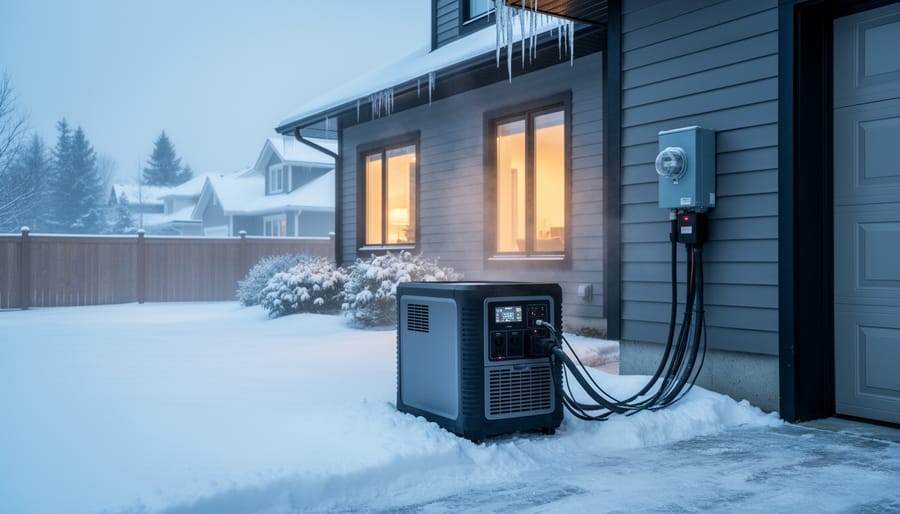
The EcoFlow Delta Pro is the heavy hitter of this roundup, and its 3,600 watts of output is the reason. In a winter outage, that headroom means you can run several large loads at once, such as a fridge, a furnace blower, and a space heater or kettle, without constantly juggling what’s plugged in. Smaller units force that trade-off. This one mostly doesn’t, which is why we treat it as the benchmark for whole-home backup among consumer-grade portable power stations in Canada.
In our hands-on evaluation, the standout trait was how little it felt strained by startup surges from motor loads. That matters for anyone searching for the best portable battery in Canada to protect a house rather than a campsite. It also sits among the high-output models that consumer testing tends to group together, so it earns its place at the top of the heavy-output tier.
Two trade-offs shape the decision. Expansion potential is the upside, since you can add capacity as your needs grow instead of buying a bigger unit later. Portability is the cost: this is a wheel-it-to-the-spot unit, not something you casually carry to a cabin dock. Treat it as a semi-permanent home fixture, kept indoors or in a heated space so winter charging isn’t blocked by the cold.
Pros
- 3,600 watts of output handles multiple large appliances at the same time.
- Strong surge tolerance suits motor loads like a furnace blower or fridge compressor.
- Expansion options let you scale capacity as your backup needs grow.
- Fits whole-home outage planning better than most portable units.
Cons
- Heavy and bulky, so it is awkward to move or carry far.
- Premium-tier value, which is overkill if you only need to power a few small devices.
- Cold-weather charging limits should be confirmed with the manufacturer before buying.
This unit suits households that want one dependable answer for outages, especially homes with several simultaneous essential loads. If your needs are lighter, such as a router, lights, and phone charging, look at a mid-size or compact pick instead. You’d be paying for output and capacity you won’t use.
2. ALLPOWERS R2500 V2 Portable Power Station | 2500W 1920Wh, Best for Mid-Size Backup With Strong Output
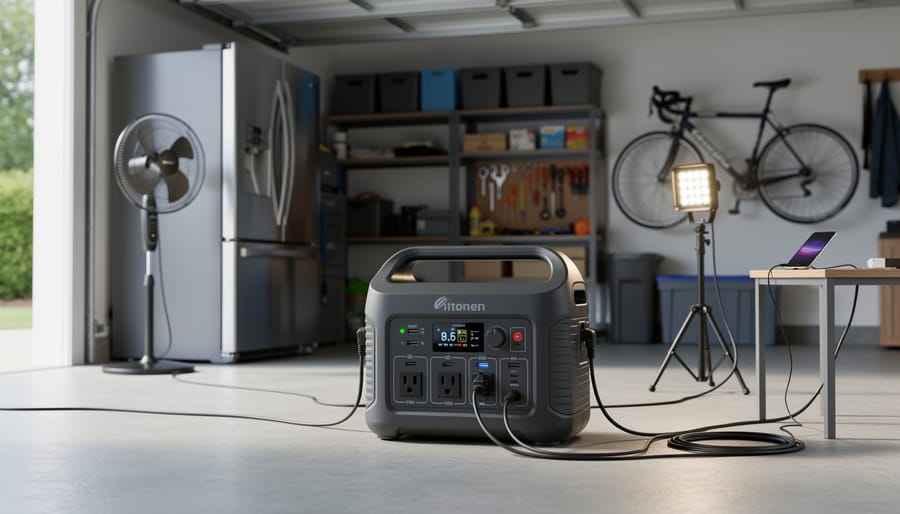
The ALLPOWERS R2500 V2 pairs 2,500W of output with 1,920Wh of capacity, and that ratio tells you most of what you need to know. The output is high enough to start and run a fridge compressor alongside a furnace blower, while the capacity sits in the middle of the range. That means it can carry essential loads through a winter outage, though not for days without recharging.
For a typical outage setup, think of the fridge cycling on and off, the furnace blower running in bursts, plus a router and some lights. Because the compressor and blower motor draw a brief surge when they start, the strong output headroom is useful. A smaller unit might trip under the same load. Estimating runtime is straightforward: divide the 1,920Wh by your combined load in watts, then trim the result to allow for inverter losses. In our assessment, this is a unit for keeping the essentials going, not for powering a whole house.
Pros
- The 2,500W output gives room to run motor loads like a fridge and furnace blower together.
- Mid-size capacity suits short to medium winter outages without the bulk of the largest units.
- It sits between compact and whole-home picks, so it suits households that want flexibility.
- Value lands in the mid-range, offering strong output for the capacity class.
Cons
- 1,920Wh will not sustain heavy loads for multi-day outages without recharging.
- Cold-weather charging limits should be confirmed with the manufacturer before relying on it.
- It is heavier and less pocketable than the compact picks.
Before buying, check two things. First, confirm the stated charging temperature range, because lithium batteries often limit charging below freezing, so plan to keep the unit indoors. Second, verify the solar input range, since short winter days make panel sizing important. Our guide to portable panels covers solar panel compatibility in more detail. If you are weighing this against fuel-based backup, it also helps to compare generator power and runtime trade-offs.
Compared with the larger EcoFlow Delta Pro, this model is easier to move and store but offers less reserve. Against the compact BLUETTI Elite 30 Mini, it handles far heavier appliances. If you are shopping for a portable power station in Canada and want strong output without paying for maximum capacity, it is a sensible middle choice.
3. Anker SOLIX S2000 Portable Power Station, Best for LiFePO4 Longevity at Home
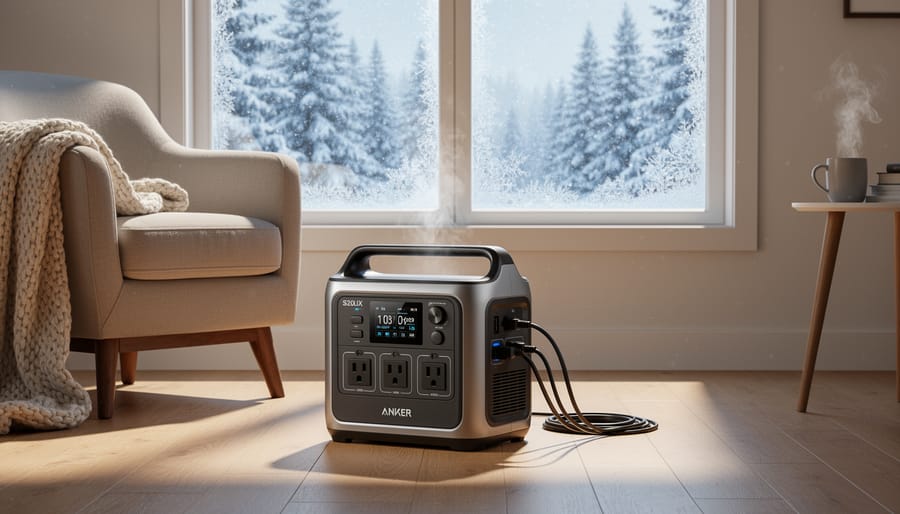
The Anker SOLIX S2000 pairs a 2,010Wh LiFePO4 battery with 1,500W of output, and that combination suits households that want a backup unit built to last. In our evaluation, we treated it as the longevity pick: not the biggest or the lightest, but the one that makes the most sense if you expect to cycle it repeatedly over many winters.
In practical terms, 1,500W of continuous output covers the loads that matter most in a cold-weather outage: a router, lights, phone and laptop charging, a CPAP machine, and a fridge or a furnace blower. Running a fridge and a furnace blower at the same time is within reach, though a kettle or space heater would push past what the unit is designed to handle. As a rough guide, divide 2,010Wh by your combined draw and shave off about fifteen percent for inverter losses to get a realistic runtime.
LiFePO4 is the reason this pick earns its “longevity” label. Lithium iron phosphate cells generally tolerate repeated deep discharges better than many other lithium chemistries, which matters if you plan to run the unit down during multi-hour outages and recharge it often. They also tend to be more thermally stable, which is reassuring for a battery that lives in a utility room or garage. In Canada, the winter habit to adopt is storing and charging it indoors, since LiFePO4 cells typically restrict charging below freezing. Confirm Anker’s stated operating and charging temperature ranges before you buy.
Pros
- The LiFePO4 battery suits repeated deep cycling, which favours long-term home backup use.
- The 2,010Wh capacity gives meaningful runtime for essential outage loads.
- 1,500W of output handles a fridge, furnace blower and small electronics together.
- It is listed on Amazon, so it is accessible to Canadian buyers.
Cons
- 1,500W is not enough for high-draw heating appliances or several large loads at once.
- Charging below freezing is typically restricted, so it needs a heated space in winter.
- It is heavier and less portable than the compact options on this list.
Value-wise, we’d place it in the premium-leaning mid-range: you are paying for chemistry and lifespan rather than raw output. If you want the most wattage, the EcoFlow Delta Pro goes further, and if you only need light carry-anywhere power, a smaller unit is simpler. For a long-lived home backup battery, the S2000 is a strong, sensible fit. Availability on Amazon changes often, so check current listings.
4. Jackery 2000 v2, Best for Extended Off-Grid Camping
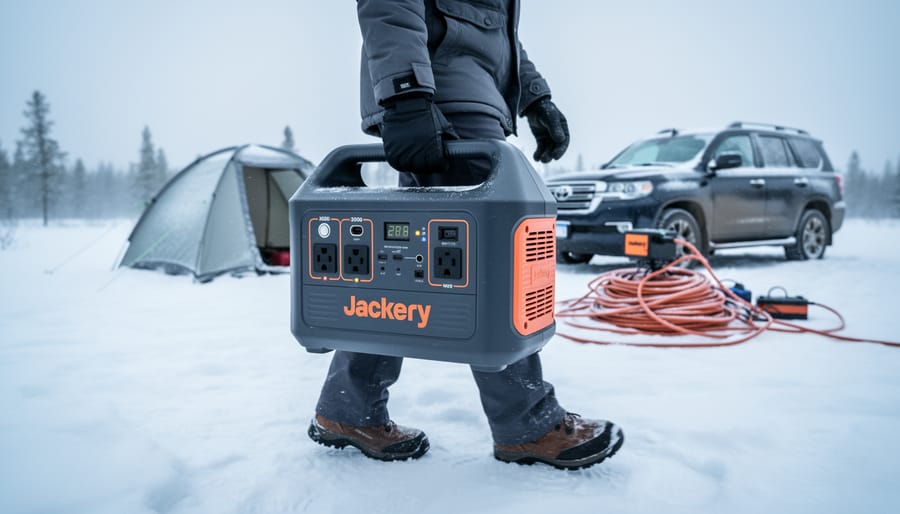
The Jackery 2000 v2 earns its place in this roundup for people who spend long stretches off the grid. Outdoor Gear Lab describes it as a favourite for extended off-grid camping, and it is listed on Amazon, though the Best Sellers list updates often, so confirm current availability before you commit. At 39 lbs, it sits in the awkward but manageable middle: you won’t casually carry it up a trail, but loading it into a truck, canoe or snowmobile sled for a cabin weekend is realistic for most adults.
Its place in our lineup is clear. It is far more capable than the compact BLUETTI Elite 30 Mini, which handles phones and lights but not a fridge or heater fan, yet it stays lighter and easier to move than the heavy-output EcoFlow Delta Pro. That makes it a sensible mid-weight choice for camp kitchens, laptops, lighting and small appliances over several days. In terms of value, we’d call it a mid-range to premium option, and the justification is stamina rather than raw output.
Pros
- Outdoor Gear Lab singles it out for extended off-grid camping.
- At 39 lbs, it is manageable to carry to a cabin, campsite or vehicle.
- It fills the gap between compact units and heavy-output backup systems.
- It suits multi-day trips better than a small battery pack.
Cons
- It is too heavy to treat as a grab-and-go pack for hiking.
- It offers less headroom than the EcoFlow Delta Pro for several large appliances at once.
- Cold-weather charging limits and solar input ranges need checking with the manufacturer.
Winter use takes some planning. Short daylight hours and low sun angles mean solar recharging will be slow, so treat panels as a top-up rather than your only source. Keep the unit in a heated tent, cabin or vehicle cab at night, since cold batteries often restrict charging. If you expect long stretches without sun, it is worth comparing inverter generator alternatives as a fuel-based backup.
For a portable power station in Canada aimed at camping and cabin life, this is a practical, middle-of-the-road pick.
5. Anker C1000 Gen 2, Best Balance of Power, Portability and Value
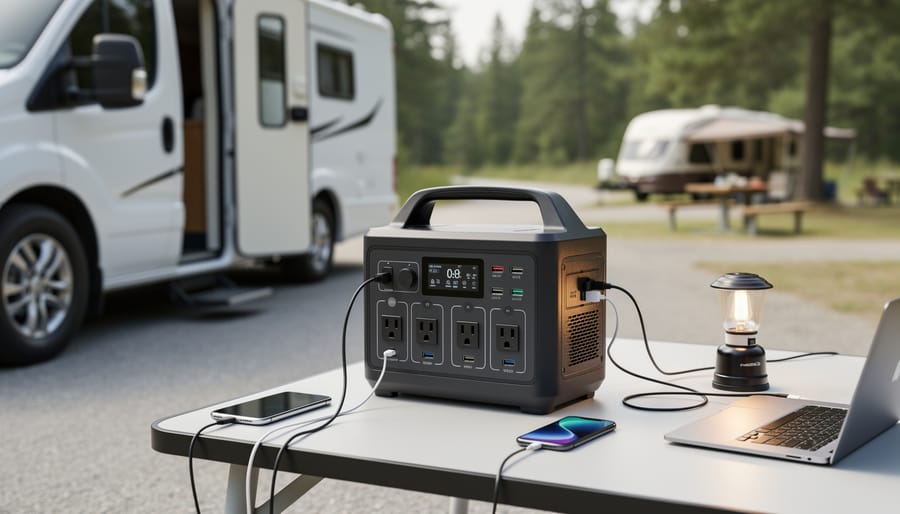
The Anker C1000 Gen 2 is the practical middle of this list. Outdoor Gear Lab says it hits a sweet spot for price, power and portability, and our hands-on impression matches that: it carries easily enough to move between rooms, a car boot and a cabin, yet it has enough output to be useful beyond phones and lights. For anyone searching for the best portable battery Canada has to offer without paying for whole-home capacity, it is a sensible starting point.
Its natural job is short outages, road trips and light cabin use. In a brief winter blackout, a mid-size unit like this can keep a router, lights, a laptop and phone chargers going for a good stretch. It can also handle a small appliance for a limited time. Runtime follows a simple rule: divide the battery’s watt-hours by your load in watts, then knock off some for inverter losses. Steady, low loads last far longer than anything with a motor or heating element. A power station in this class suits modest loads well, but it is not meant to carry a furnace blower or a fridge through a long outage. If that is your goal, the larger picks above are a better fit.
Pros
- Offers a strong balance of power, portability and value for a mid-size unit.
- Light enough to move easily between home, car and cabin.
- Handles routers, lights, laptops and phone charging comfortably.
- Works well for short outages and weekend trips.
Cons
- Cannot support large appliances for an extended outage.
- Needs to be kept and charged in a heated space during deep cold.
- Runtime shortens quickly with higher-wattage loads.
- Sale pricing varies, so check current offers before buying.
Value here sits in the mid-range: more capable than a compact unit, far less costly than a whole-home system. Pricing changes with sales, so confirm current availability and Canadian warranty terms with the retailer before you decide. As with any lithium unit, check the manufacturer’s stated cold-weather charging limits, since that matters more in Canada than almost any other spec.
6. BLUETTI Elite 30 Mini Portable Power Station, Best Compact Option for Light Loads
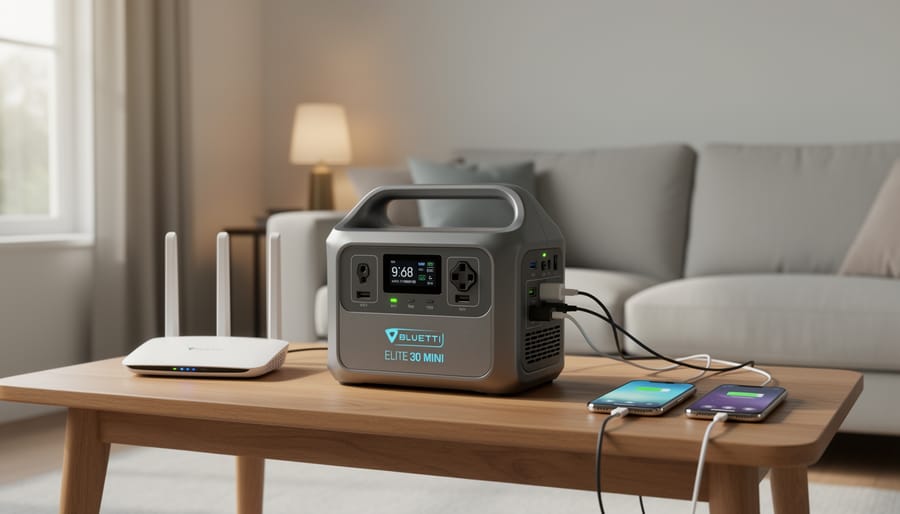
The BLUETTI Elite 30 Mini is the small end of this roundup, and we treat it as a carry-anywhere companion rather than a home backup solution. With 288Wh of capacity and 300W of output, it suits phones, laptops, camp lights and a router, the kind of low-draw gear that keeps you connected and lit during a short outage or a weekend at the cabin. Among the options a Canadian buyer would consider for a portable power station, it is the easiest to pack and the simplest to understand. It is listed on Amazon, and in words, it sits firmly in the budget tier of this list.
Pros
- Its compact size makes it easy to toss in a backpack, car trunk or emergency kit.
- 288Wh is enough to recharge phones and a laptop several times over.
- The 300W output covers lights, a router and small electronics comfortably.
- It is the most approachable and affordable entry point among our six picks.
Cons
- The 300W ceiling rules out a fridge, furnace blower and most kitchen appliances.
- Limited capacity means a long winter outage will drain it quickly, even with light loads.
- It cannot stand in for the larger units if you want whole-outage coverage.
- Sub-zero charging behaviour should be confirmed with the manufacturer before relying on it outdoors.
Know the limits before you buy. Anything that pulls more than 300W at once is off the table, and motor-driven loads that surge on startup are a poor match for a unit this size. If your goal is keeping a fridge cold or a furnace running through a multi-hour winter outage, skip this one in favour of the Anker SOLIX S2000 or something larger. If you mainly want to stay charged, keep a router alive and run a few lights, it does that job without the weight or bulk of the bigger power stations.
Frequently Asked Questions About Portable Power Stations in Canada
Can a portable power station run a fridge during a winter outage?
Yes, if the unit’s continuous output covers the fridge’s startup surge and its watt-hours cover the hours you need. A mid-size or large unit such as the Anker SOLIX S2000 (2,010Wh, 1,500W) is the sensible starting point, while a 288Wh unit like the BLUETTI Elite 30 Mini is built for lights, phones and a router, not a fridge.
Do power stations work in freezing temperatures?
Most will discharge in the cold, but LiFePO4 batteries typically restrict or block charging below freezing to protect the cells. Keep the unit indoors or in a heated space, and check each manufacturer’s stated operating and charging ranges before you buy.
Can I recharge with solar panels in winter?
You can, though short daylight, low sun angle and snow cover limit how much energy you collect. Cold, clear conditions can actually suit panels, so plan around available daylight hours and confirm the unit’s solar input range.
Are LiFePO4 batteries better than other lithium types?
They generally handle repeated deep cycling well and suit long-term home backup, which is why the Anker SOLIX S2000 earns its place for longevity. Other chemistries can be lighter, so the better choice depends on whether you value lifespan or portability more.
Will I pay duty when buying from a US seller?
Possibly, since cross-border orders can trigger duty and brokerage fees, and lithium batteries face carrier restrictions. Confirm the shipping terms and Canadian warranty coverage with the seller before checkout.
How do I choose the right capacity?
Add up the watts of the devices you need, estimate the hours, and multiply to get watt-hours, then add a margin for inverter losses. Choosing a power station in Canada also means leaving headroom for cold-weather efficiency losses.
Key Details to Confirm Before You Buy
Before you buy, treat the specifications in this roundup as a starting point and verify the rest yourself. The figures we leaned on are the Anker SOLIX S2000’s 2,010Wh LiFePO4 battery with 1,500W output, the BLUETTI Elite 30 Mini’s 288Wh capacity and 300W output, and the EcoFlow Delta Pro’s 3,600 watts. Everything else should be confirmed with the manufacturer or retailer.
Start with availability. Amazon’s Portable Power Stations Best Sellers list updates frequently, so a model that is listed today may be gone or replaced tomorrow. Next, ask about Canadian warranty terms, since coverage can differ for units bought from a US storefront. Finally, check each unit’s stated cold-weather charging limits and its solar input range, because these decide how it behaves in a sub-zero outage with short daylight.
If any of these details are unclear on a listing, ask the seller directly before ordering a portable power station in Canada.
The best portable power station in Canada comes down to matching capacity to your outage and your winter. For large backup, the EcoFlow Delta Pro is the pick for running several big loads at once. For mid-size flexibility, the ALLPOWERS R2500 V2 and the Anker SOLIX S2000 cover fridge-and-furnace-blower territory, with the SOLIX’s LiFePO4 chemistry suiting long-term home use. If you want something lighter, the Anker C1000 Gen 2 balances power and portability, and the BLUETTI Elite 30 Mini handles phones, laptops and a router without much fuss.
Let Canadian conditions make the final call. Sub-zero temperatures, charging limits in the cold and short daylight for solar all matter more than a headline spec. Whichever unit you choose, any power station in Canada will perform best if you store and charge it somewhere sheltered.
Before you buy, confirm current model availability and warranty terms with the seller. Amazon’s best-seller list changes often, so a unit that suits you today may be replaced tomorrow. Our research is independent and nonprofit, and we have no stake in which one you pick. The best portable battery in Canada is simply the one that fits your loads, your climate and your routine.
Final Verdict
For a household that wants one unit to carry a whole Canadian winter outage, the EcoFlow Delta Pro is our top pick. Its 3,600-watt output gives it the headroom to run several large appliances at once, which is what separates a true backup system from a camping battery. It suits homeowners who value capacity and output over portability, while lighter needs are better met by the smaller picks above.